
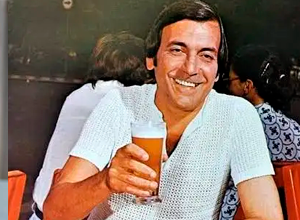
Milton
Banana
Rio de Janeiro – RJ, 1935
Rio de Janeiro – RJ, 1999
A drummer, Antonio de Souza – better known as Milton Banana – is one of the most important percussionists in the history of Brazilian music. Nicknamed the “King of Rhythm,” he expanded the expressive possibilities of the drum set and became the musician responsible for defining the rhythmic foundation of Bossa Nova.
In 1958, alongside João Gilberto, he recorded “Chega De Saudade” (Antonio Carlos Jobim/Vinicius de Moraes) and “Bim Bom” (João Gilberto), released that same year on a 78 rpm record. The following year, these recordings were included in the landmark album Chega De Saudade (1959). Milton Banana’s subtle and innovative drumming established the rhythmic language that would become inseparable from Bossa Nova.
In 1962, he participated in the historic Bossa Nova concert at Carnegie Hall in New York. A recording of the concert was released the following year as Bossa Nova at Carnegie Hall (1963), featuring his drumming alongside João Gilberto’s guitar and vocals on “Outra Vez” (Antonio Carlos Jobim).
Also in 1963, Audio Fidelity released O Ritmo e o Som da Bossa Nova – Milton Banana com Conjunto Oscar Castro Neves. Recorded with the Oscar Castro Neves Quartet, the instrumental album presented a refined Bossa Nova repertoire, including classics such as “Você e Eu” (Carlos Lyra/Vinicius de Moraes), “Desafinado” (Antonio Carlos Jobim/Newton Mendonça), and “Chega De Saudade” (Antonio Carlos Jobim/Vinicius de Moraes), as well as compositions by Oscar Castro Neves, João Roberto Kelly, Pernambuco, and Antônio Maria.
In 1964, he joined Stan Getz, João Gilberto, Tom Jobim, and Astrud Gilberto in the recording of the iconic album Getz/Gilberto. The album became an international success and won four awards at the 7th Annual Grammy Awards, solidifying Bossa Nova’s global impact.
Still in the 1960s, he formed the Milton Banana Trio. With the group, he recorded some of the most celebrated instrumental albums in Brazilian music, particularly Balançando com Milton Banana Trio (1966), further establishing his legacy as one of the architects of modern Brazilian rhythm.